You have 0 items in your cart
Be Seen. Stay Alive. The Visibility Challenge Every Rider Must Own.
Let’s be honest with each other for a minute.
You already know that car drivers don’t always see you. You’ve felt it — that moment where a driver starts drifting into your lane, or a car pulls out from a side street like you don’t exist. That cold rush of adrenaline. The quick evasion. The heart pounding afterward.
“They looked right through me.”
It happens to riders every single day. And while we can’t control what every distracted driver does, we can control how visible we make ourselves. Visibility isn’t just a piece of gear — it’s a strategy. It’s a mindset. And it is absolutely something every rider can improve, starting with your next ride.
At Road Guardians, our goal is zero fatalities. Not fewer fatalities. Zero. And we know that won’t happen by accident — it happens because riders like you commit to being better. Visibility is one of the most powerful tools you have in that commitment.
So let’s get into it.
The Reality Check: Why You’re Hard to See
Motorcycles occupy a fraction of the space that a car does. You’re narrow, you can be hidden in a vehicle’s blind spot in an instant, and at any distance, you’re easy to overlook — especially for a driver who isn’t actively looking for you. Research consistently shows that “I didn’t see the motorcycle” is one of the most common statements made after a crash involving a rider.
Here’s the truth that might sting a little: some of that is on us. Riding in dark gear on a dark bike, hanging in a driver’s blind spot, sitting in the center of a lane at night with a single dim taillight — we can make ourselves harder to find. The good news? Every one of those things is fixable.

What You Can Do: A Visibility Playbook
Gear That Works For You, Not Against You
Your gear is your first line of visibility. This doesn’t mean you have to look like a construction cone — it means making smart choices.
High-visibility yellow, orange, and bright red riding jackets are proven to dramatically increase how quickly other drivers detect a motorcycle in their field of view. Even if you love your all-black setup, consider adding a high-vis vest over it, or look for gear that incorporates retroreflective panels. That reflective material is especially valuable at dusk and at night, catching headlights and throwing light back toward oncoming drivers.
Your helmet is another opportunity. A bright or white helmet is more visible than a dark one, full stop. Some riders add reflective tape to the back and sides of their helmets — simple, affordable, and effective.
Ask yourself this: if a distracted driver glanced your way for just half a second, would they notice you?
Light Up Your Ride
Your headlight is your handshake with other drivers, it says I’m here. But you can go further.
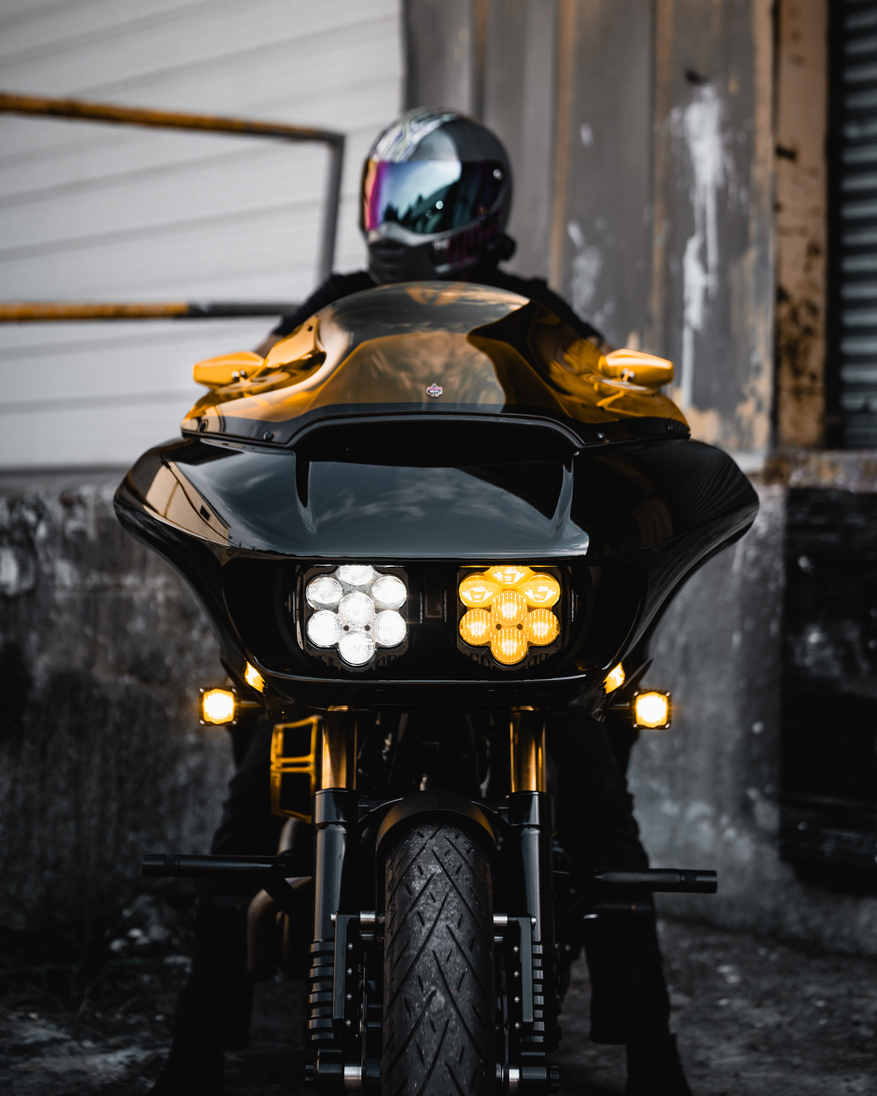
Many modern motorcycles allow for auxiliary lighting upgrades. LED light bars, fog lights, or even simple light strips along your fairing or frame add to your visual signature. In a sea of headlights, the more dimension your lighting profile has, the more easily your brain — and another driver’s brain — interprets you as an approaching object.
Running your high beam during the day (where legal and appropriate) can improve your conspicuity significantly. Some riders also use headlight modulators, which cause the headlight to pulse at a rate that is highly attention-grabbing to the human eye without being blinding or illegal in most states.
Consider the danger of your side profile, it’s often the angle from which a turning or merging driver will first encounter you, and a motorcycle with no side lighting can virtually disappear in a driver’s peripheral vision. Adding amber or white LED strips along your lower fairing, saddlebags, or frame rails gives you a presence from the side that your headlight and taillight simply can’t provide.
Don’t overlook your taillight. Upgrading to a bright LED unit and adding brake light modulators, devices that cause rapid flashing when you apply the brakes, can be the difference between a driver behind you recognizing that you’re stopping in time or not.

Lane Positioning Is Visibility Strategy
Where you ride within your lane matters enormously — and it’s something you can change right now, with zero cost.
Riding in the left third of your lane when approaching intersections puts you in the line of sight of cross-traffic and oncoming left-turners. It also keeps you out of the oil-drip zone in the center. Riding in the right third gives you visibility past the vehicle ahead and puts you where drivers approaching from side streets are more likely to look.
The key principle: never ride in someone’s blind spot. Adjust your speed and position so that you are either ahead of a vehicle or back far enough to be in their mirrors. Lingering alongside another vehicle for any extended period is one of the most dangerous places you can be on a road.
On multi-lane roads, position yourself where you can be seen in multiple mirrors at once. Think about what the drivers around you can and cannot see — and then ride in a way that answers that question in your favor.
Move — and Be Predictable About It
A stationary object is easier to overlook than a moving one. Subtle lane position changes within your lane can help drivers register your presence. This is especially useful when approaching intersections or merges — a slight, intentional shift in position creates motion that catches the eye.
At the same time, be consistent and predictable in your movements. Erratic lane changes or sudden speed variations make it harder for drivers to track and anticipate where you’ll be. Visibility isn’t just about being seen in the moment — it’s about giving other drivers enough information to make good decisions around you.
Use your signals. Always. Even when it feels unnecessary. A flashing turn signal gives nearby drivers critical advance information about your intentions.
Manage Intersections Like Your Life Depends on It — Because It Does
Intersections are where a disproportionate number of motorcycle crashes occur. A car turning left across your path is one of the most common and most deadly collision types for riders.
When approaching any intersection — even a green light, even one you’ve passed through a hundred times — ask yourself: who might not see me right now? Cover your brake. Scan left, right, and left again. Watch for front wheels — a turning front wheel is the first sign a car is about to pull out. Give yourself an out.
Position yourself in the lane where you are most visible to the vehicles most likely to conflict with you. That usually means away from the center of your lane and toward the side where cross-traffic originates.
The Commitment
Visibility isn’t a single purchase or a one-time decision. It’s a practice — a habit built into every ride, every gear choice, every lane position decision.
We challenge you to look at your setup with honest eyes before your next ride. What’s one thing you could change that would make you easier to see? A piece of reflective tape? A brighter jacket? A light upgrade? A lane position habit you’ve been meaning to build?
You don’t have to overhaul everything at once. Just commit to being a little better today than you were yesterday.
That’s how we get to zero.
Ride smart. Ride bright. Ride home.
Road Guardians is dedicated to reducing motorcycle fatalities through education, personal responsibility, and community. Our six-area safety framework — Apparel, Laws, Impaired Riding, Visibility, Education, and First Response — addresses everything a rider needs to give themselves and their fellow riders the best possible chance of a safe journey. Learn more at roadguardians.org.

